
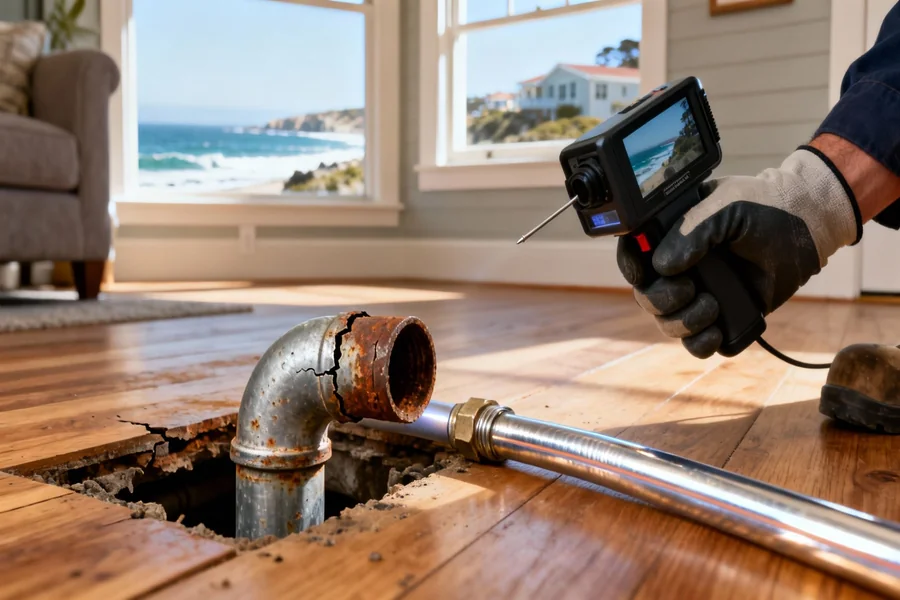
Most Houston homeowners do not think about their pipes until something goes wrong. A stain on the ceiling. A drop in water pressure so gradual it almost goes unnoticed. A plumber out for the third time in two years fixing yet another section of the same failing line.
The trouble is, by the time these problems become obvious, the pipe system has usually been degrading for years. And the cost of ignoring it long enough, water damage, mold, structural repairs, tends to dwarf the cost of addressing it proactively.
If your home is more than 25 to 30 years old and you have been seeing the signs below, this article will help you understand what your plumbing is trying to tell you, and what your real options are.
Why Houston Homes Face Particular Plumbing Challenges
Houston’s housing stock is older than many people assume. Large portions of neighborhoods like Kingwood, Bellaire, Pasadena, and Katy were built in the 1960s through the 1980s, a period when galvanized steel and early copper pipe were standard materials. Both have a finite lifespan.
Galvanized steel corrodes from the inside out. The zinc coating that originally protects the pipe degrades over decades, leaving exposed steel that rusts, restricts flow, and eventually fails. Copper holds up better but is not immune, especially in homes where water chemistry or soil conditions accelerate corrosion.
Houston’s climate adds pressure to the problem. Fluctuating temperatures, high humidity, and the occasional hard freeze hit pipes that were never designed to last more than 40 to 50 years. Many of them have already exceeded that.
The Warning Signs That Spot Repairs Are No Longer Enough
There is a difference between a one-off plumbing problem and a system that is telling you it is done. Here is what to watch for.
Recurring Leaks in Different Parts of the House
One leak in one place is a repair. Two leaks in different locations within 12 months is a pattern. Three or more, especially in a home with old galvanized or original copper, is a system problem.
Spot repairs buy time. They do not fix the underlying corrosion or deterioration happening throughout the rest of the pipe network. If a plumber has been out multiple times in recent years for different leaks, the pipes are failing at multiple points and the patch-and-pray approach is getting expensive.
Rust-Colored or Discolored Water
Brown, orange, or reddish water at the tap is one of the more alarming signs, and rightly so. In homes with galvanized steel pipes, rust accumulates on the interior pipe walls and breaks free when water pressure fluctuates, sending it straight to your faucet.
This is not just an aesthetic problem. Corroded pipes can affect water quality in ways that matter for cooking, bathing, and drinking. If you are seeing discoloration at multiple fixtures, especially first thing in the morning, the source is almost certainly your supply lines.
Low Water Pressure Throughout the Home
Weak showers and slow-filling sinks are a daily frustration, but they are also diagnostic. Low pressure in a single fixture usually points to a local issue, a clogged aerator or failing valve. Low pressure throughout the house, especially in older homes, often means significant buildup inside the pipes themselves.
Galvanized pipes are particularly prone to this. As they corrode, the interior diameter shrinks. A pipe that was once 3/4 inch may effectively be half that after years of rust accumulation. The result is reduced flow that no amount of fixture-level repairs will solve.
Pipes Over 30 to 40 Years Old
Age alone is a valid reason to have your plumbing assessed. The American Society of Home Inspectors and most licensed plumbers agree that galvanized steel supply lines have a useful life of roughly 40 to 70 years, though real-world performance often falls short of that upper range depending on water quality and installation conditions. Copper can last longer but is not immune to pitting corrosion and pinhole leaks.
If you do not know what your pipes are made of or when they were installed, a licensed plumber can assess this relatively quickly. Homes built before 1985 in greater Houston should be evaluated.
Pinhole Leaks in Copper Lines
Pinhole leaks are a specific failure mode common in copper pipe systems. They develop when water chemistry, particularly low pH or high chlorine levels, causes pitting corrosion on the interior pipe wall. One pinhole can be repaired. A pattern of pinholes across multiple locations is a sign that the copper throughout the house is at a similar stage of deterioration.
Left alone, these leaks cause hidden water damage inside walls, under floors, and in ceilings. By the time they are discovered, secondary damage is often already significant.
Failed Hydrostatic Test
If you are in the process of selling a Houston home or filing an insurance claim, a hydrostatic test may be required. This test pressurizes the drain system to identify leaks. A failed test is not just a negotiation problem. It is confirmation that the plumbing system has compromised integrity that needs to be addressed before the transaction or claim can move forward.
What a Whole-House Pipe Replacement Actually Involves
Many homeowners put off pipe replacements because they imagine weeks of disruption, exposed walls, and separate contractors trooping through the house. The reality, when you hire the right crew, is considerably more manageable than that.
Here is how a professional whole-house repipe typically works:
Day one: The crew arrives, maps the pipe layout, and begins accessing lines through carefully cut openings in walls and ceilings. Water is shut off during working hours only. Most repipe specialists restore water at the end of each working day, so the typical downtime window is around five to six hours per day.
Material: The current standard for residential repiping is Uponor PEX-A, a flexible, cross-linked polyethylene pipe that outperforms both rigid copper and standard PEX-B in freeze resistance, expansion fitting reliability, and long-term durability. It does not corrode, does not scale up internally, and carries a strong manufacturer warranty.
Completion: Most whole-house repipes in standard Houston homes are completed in one to two days. After the new lines are pressure-tested and permitted, access holes are patched. A repipe crew that handles drywall repair and paint in-house means homeowners are not left coordinating a second contractor or living with holes in their walls.
Warranty: A transferable lifetime warranty on the repipe work is a significant advantage for homeowners who may eventually sell. It protects the next buyer and adds a legitimate talking point during real estate transactions.
Pre-Sale and Insurance Situations: When Timing Matters Most
For homeowners preparing to sell, plumbing condition is increasingly scrutinized. Buyers in the Houston market, particularly in older suburbs like Sugar Land, Cypress, and Spring, are more likely to request hydrostatic testing as part of their inspection process. A flagged plumbing system can kill a deal or result in a price reduction that far exceeds the cost of repiping proactively.
Insurance companies are also paying attention. Some carriers are beginning to exclude coverage for water damage in homes with galvanized or aging copper supply lines, or charging significantly higher premiums. Getting ahead of this before a claim situation arises is worth considering.
The Difference Between Repair and Replacement: A Practical Framework
Not every plumbing issue requires a full repipe. Here is a rough decision framework:
- Single leak, isolated location, relatively young pipes: Spot repair is likely appropriate.
- Two or more leaks in different areas within one to two years: Start a professional assessment.
- Recurring leaks plus low pressure plus discolored water: All three together is a strong signal the system is failing broadly.
- Galvanized pipes over 40 years old, regardless of active symptoms: A proactive assessment is warranted.
- Failed hydrostatic test or active slab leak: Act quickly; this has moved beyond the repair-versus-replace question.
The cost of repiping a Houston home typically falls somewhere between $4,000 and $16,000 depending on home size and fixture count. That range sounds wide, but companies using a fixed per-fixture pricing model can give homeowners a reliable estimate before any work begins, without location-based markups that inflate quotes for no good reason. Financing options at 0% for 24 months, where available, can make the decision significantly easier for homeowners who need the work done but are watching cash flow.
Key Takeaways
- Recurring leaks in different parts of the house, not just repeat repairs in the same spot, are one of the clearest signs a pipe system is failing broadly.
- Rust-colored water at multiple fixtures usually means corroding galvanized supply lines, not a fixture problem.
- Low pressure throughout the home points to internal buildup, which spot repairs cannot address.
- Homes built before 1985 in Houston should be evaluated even if active symptoms are not yet obvious.
- A whole-house repipe with Uponor PEX-A, drywall repair included, and a transferable lifetime warranty is a more complete and cost-effective solution than years of escalating patch repairs.
FAQ
How do I know if my Houston home has galvanized steel pipes? The simplest way is to find an exposed pipe section near the water heater, under a sink, or in a crawl space and look at the material. Galvanized steel has a dull grey appearance and feels heavier than copper, which has a reddish-orange or green-patinated look. A licensed plumber can confirm this quickly during a free estimate visit.
Can I just keep repairing individual leaks instead of repiping? In the short term, yes. But if leaks are recurring in different locations, each repair is buying less time than the last. The cost of repeated plumber visits, water damage remediation, and potential mold treatment adds up. For homes with systemically failing pipes, the math on repiping usually makes sense within two to three years of ongoing repairs.
How long does water get turned off during a whole-house repipe? For most Houston homes, water is off during working hours only, roughly five to six hours per day. Repipe crews typically restore water at the end of each workday so homeowners can function normally in the evenings. Most projects are completed in one to two days total.
Does a whole-house repipe require permits in Houston? Yes. Repipe projects require permits and inspections in Houston and across Harris, Montgomery, Fort Bend, and surrounding counties. A licensed repipe contractor will pull the required permits and schedule inspections as part of the project scope. Be cautious of any contractor who suggests skipping this step.
Will repiping increase my home’s resale value? Directly, it is unlikely to increase the appraisal dollar-for-dollar. What it does do is remove a significant red flag during buyer inspections, prevent deal-killing failures on hydrostatic tests, and, if the repipe carries a transferable lifetime warranty, provide a tangible reassurance for buyers. Sellers who repipe before listing often find the transaction proceeds more smoothly with fewer negotiated concessions.
Closing Thoughts
Plumbing problems have a way of escalating quietly until they become expensive urgencies. For Houston homeowners in older homes, reading the early signals, recurring leaks, low pressure, discolored water, and aging pipe materials, puts you in a position to act on your timeline rather than react to a crisis.
Understanding what a full pipe replacement involves, the materials, the realistic timeline, the cost structure, and what to expect from the process, takes the uncertainty out of a decision that a lot of homeowners put off longer than they should.
If the signs in this article sound familiar, a professional assessment is the logical next step.