
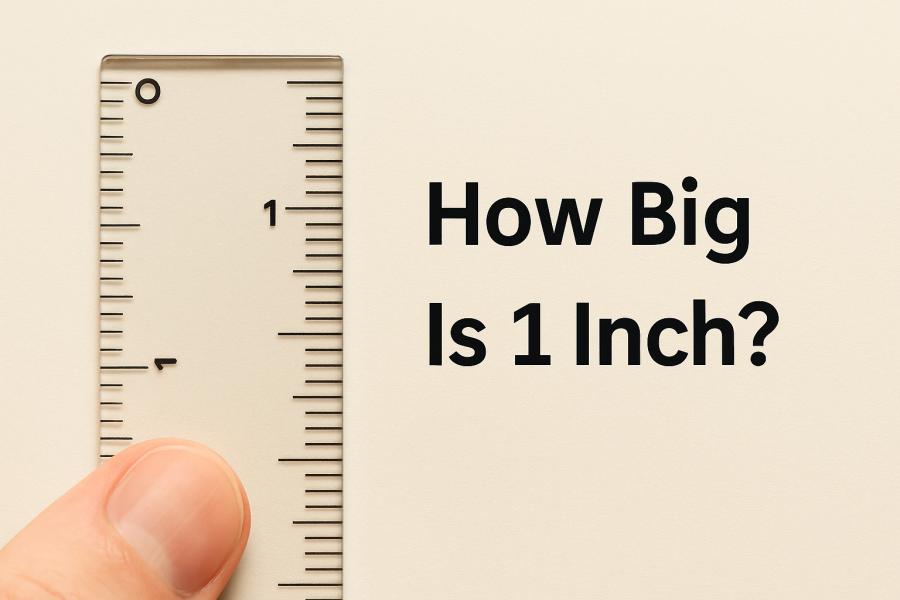
Have you ever wondered exactly how big is 1 inch?It’s a small quantity, but we use it all the time in our daily lives.’ Whether comparing screen sizes, the length of fabric or phone dimensions, an inch is a convenient reference to use when taking a measurement.
That sounds like a simple thing, but many people can’t imagine what one inch looks like without using a ruler. In this post, we’re going to tell you what an inch is, how to measure something using inches and list its examples in real-life situations.
What Does 1 Inch Mean?
An inch is an imperial and United States customary unit of length. It is part of the imperial system.
There are 2.54 centimeters in one inch, under the metric system that most of the world uses! This information comes in handy when you try to convert measurements from one standard or system to another, like if you’re shopping for goods online which are measured using different systems of measurement.
Well, 1 inch = 2.54 cm, and that conversion is the one thing those two systems have in common.
How Big Is 1 Inch?
When people ask “how big is 1 inch,” it’s because an inch doesn’t sound like much, but it can make a big difference in certain cases.
To picture one inch, here are a few easy comparisons:
- The width of an adult thumb at the widest point is roughly 1 inch.
- The diameter of a U.S. quarter coin is just under 1 inch (0.955 inches to be exact).
- Most standard paper clips are about 1 inch long.
- The edge of a postage stamp is close to one inch.
If you remember one of these objects, you’ll have a quick visual idea of what one inch looks like.
Why the Inch Still Matters
Even though many countries use the metric system, inches remain important in daily life.
Here’s why:
- Product sizes – Screens, shoes, and furniture are still listed in inches.
- Construction work – Many tools and blueprints in the U.S. use inches and feet.
- Fashion and tailoring – Clothing measurements often rely on inches, especially for chest or waist sizes.
- Digital devices – Screen sizes, such as a 6-inch phone or 15-inch laptop, still use this unit.
This shows how the inch connects both the physical and digital world.
How to Measure 1 Inch Without a Ruler
Sometimes you don’t have a ruler or tape measure around. No problem — here are a few simple tricks to measure one inch:
- Use your thumb: The width of your thumb near the base is close to an inch for most adults.
- Use coins: Two stacked U.S. quarters equal almost 2 inches, so one is close to 1 inch.
- Use credit cards: A credit card’s width is about 3.37 inches, so one-third of that is roughly an inch.
- Use your phone screen: Most smartphones show about an inch for every 2.5 cm on a zoomed photo grid or scale app.
These simple hacks work well if you need a rough measurement on the go.
1 Inch in Different Units
Understanding how one inch compares to other measurement systems helps you convert easily.
| Unit | Equivalent of 1 Inch |
| Millimeters | 25.4 mm |
| Centimeters | 2.54 cm |
| Feet | 1/12 foot |
| Yards | 1/36 yard |
| Meters | 0.0254 meters |
This chart helps you switch between metric and imperial measurements depending on your needs.
Everyday Objects That Measure Around 1 Inch
- A U.S. Quarter Coin – The diameter is about 0.955 inches, just slightly less than 1 inch.
- Adult Thumb Width – The width of an average adult thumb (at the base) is close to 1 inch.
- Standard Paper Clip – Small paper clips are usually about 1 inch long.
- Postage Stamp – A regular stamp’s edge is roughly 1 inch wide.
- Guitar Pick – Many picks are between 0.9 and 1 inch in size.
- Bottle Cap – The diameter of a typical plastic soda bottle cap is around 1 inch.
- Key Top Section – The flat head of a small house key measures about 1 inch wide.
- Eraser End of a Pencil – The pink eraser attached to a pencil is roughly 1 inch tall.
- Stack of 10 Business Cards – Together, they measure close to 1 inch in height.
- Dice Edge – A standard gaming die (used in board games) often has sides about 1 inch across.
Why 1 Inch Matters in Precision
When it comes to design, manufacturing and engineering, precision is everything. A small variance of just a half inch can alter the way two components fit together. Professional workers have it easier with tools such as rulers, calipers and digital measurement systems for this very reason. The inch is just a useful, convenient standard for all those uses. When you’re arranging an online purchase, or cutting material for a project, knowing what one inch really looks like can help prevent expensive errors.
Fun Ways to Visualize 1 Inch
To make it easier to remember, here are some fun ways to visualize an inch:
- About the same length as the top joint of your index finger.
- The height of a stack of 10 standard business cards.
- The diameter of a bottle cap.
- Roughly the same as the length of a small key.
These examples help you estimate quickly without needing tools.
The Inch in the Digital World
In the tech world, we use inches to measure digital displays. When a phone is described as having a “6.5-inch screen,” that means the diagonal length from one corner of the screen to the opposite corner is 6.5 inches.
The same goes for monitors, tablets and TVs. Though pixels reign supreme in digital design, inches are still a physical standard that users can relate to across the board.
FAQs
How big is 1 inch compared to centimeters?
One inch equals 2.54 centimeters. This is a fixed and widely accepted conversion standard.
Can I measure 1 inch without a ruler?
Yes. Use your thumb, a coin, or a credit card for a quick estimation.
What objects are about 1 inch long?
A quarter coin, a paper clip, or the width of an adult thumb are all close to one inch.
Why do we still use inches?
Many industries in the U.S., including construction and design, still use inches for simplicity and consistency.
Conclusion
Now you see how big 1 inch is, and how practical it is. It’s a small thing, but it can be found almost anywhere: from paper sizes to screens and instruments.
The next time you see those dimensions on a computer screen — or next time you’re coding, quilting, building or creating something else anew — now you know what one inch looks like without a ruler.
One little inch between daily life, technology and craft – not everything has to be the handle.